
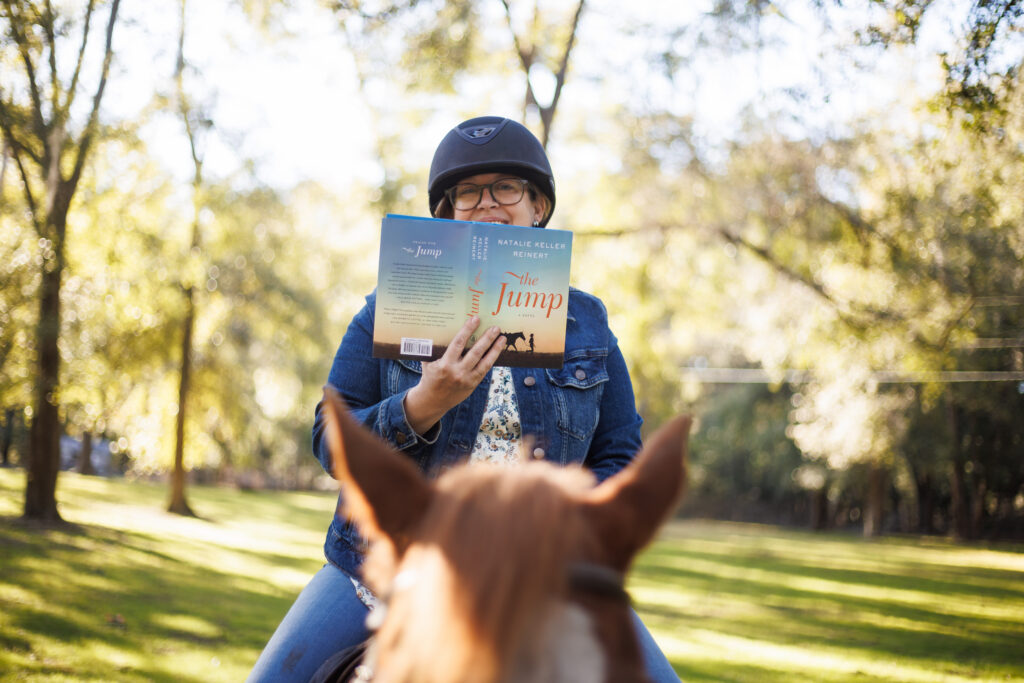
I spend most of my time writing about professional equestrians. Not real ones, but fictional characters, all grounded in the reality of equestrian life. My most popular books, The Eventing Series, are about a professional trainer with an exterior of sandpaper and a heart of gold, who loves her horses and would do anything for them. Her fierce love grows, in time, to a forcefield she wraps around any human in her sphere as well . . . fellow riders, students, anyone who finds a way to get close to her.
I love Jules, truly, but something else about the horse world was nagging at me. A sort of side-effect of our camaraderie, and our close-knit barn families.
Small worlds can hold big secrets.
When I was ten years old, I rode at a hunter/jumper barn on the east coast of Florida. This was schooling-show territory, not A-circuit hunter land (and anyway, it was the early 90s and the circuits of today hadn’t been developed yet). We went to a show at a hunter barn a few miles away. I showed in short stirrup. I think I might have ribboned in the hunter hack, my favorite class. On the way back, a 17-year-old student, the oldest one in our group, cried in the passenger seat of the farm truck. We little girls sat in the back, piled atop one another like extra tack, while our trainer told her with gentle, chiding words, not to get so close to riders at the other farm.
I wrote in my school journal, a writing project I loved, Becky was hanging out with people who were telling secrets about our farm.
I can’t even imagine what my teacher thought of that entry.
Secrets, politics, whispers. I was raised to think they were part of equestrian life. And they are.
A month or two ago, a former working student accused her ex-boss, a prominent, one might even say beloved, rider, of a number of cruel practices. She did it on Facebook because that’s where we put our secrets now. I clicked the comments expecting a take-down of the accusations and instead saw people I knew agreeing, saying they’d seen it all, they’d known it all along.
I thought: I didn’t know any of this. I’ve supported this person. My own friends wouldn’t send this person a horse? Why didn’t I know?
And then I thought: Can’t believe I already wrote this book.
The Jump was originally titled Working Student and it really did start out with a simple idea: I wanted to write about being a working student. The hardship and the hope, the endless days and the short, short nights, the empty cupboards and the leaky faucets and the ironclad friendships and the infuriating rivalries. Learning from your hero and wondering how to keep going when you’ve got nothing left to give . . . and then just doing it.
As I spent months thinking about Working Student, well before I started writing it, a domino-fall of disgraced top trainers clattered around the horse world. Cruelty in dressage. Cruelty in jumping. Cruelty in eventing. People took to Facebook to discuss these scandals, to take their sides.
People who “knew it all along,” and people who would never, ever believe it, even with video or photographic evidence. People who said it wasn’t cruelty, just smart training. People who said it was all blown out of proportion. People who said it was a moment in time, forgetting, maybe, that animals don’t have a sense of future, or hope, just of this moment — it’s all they’ve got.
The idea was really taking shape now: a working student who takes a job with her idol, who would do anything to make it in the sport, not knowing that “anything” really depends on who you’re working for.
What if the whisper network doesn’t include you?
The book that became The Jump isn’t a book about cruelty in horse sports. I wouldn’t want to write that, and I wouldn’t want to read it, either. The Jump is about friendship, and it’s about dreams, and it’s about falling in love with your horse and then realizing that love really does require sacrifice. It’s also about this big little equestrian world we live in, and gaslighting trainers, and the impossible demands of horse economics (horse eats a dollar, you lose a dime, something like that), and taking a chance when everyone expects a good decision from you and you’re just not emotionally capable of making a good decision.
I learned at ten years old that the horse world is full of crazy secrets, even if I didn’t know what they were yet. I stuck around, and a few decades later, I know some of those secrets. And yes, I’m still here. I’m still getting fooled. I’m still trying to get wiser about this stuff. I may not know which trainer is hiding what, but at least I can always put my horse first. That part of the horse world is the part that matters. The horse part.
And the horse part is why we are all still here, right? It’s why we keep making these decisions. At The Jump’s launch party, graciously moderated by trainer and author Tik Maynard, a member of the audience asked me what I’d say if someone asked me for advice about becoming a working student. I said: “I’d say yes, they should do it.” I would never make the mistake of choosing something with my head instead of my heart. I would always follow my worst, craziest, most expensive, most impetuous dreams, and I’ll happily urge anyone who asks me to do the same.
I think Brooke and Roxie, my rider-and-horse team in The Jump, would agree.
Although maybe they’d suggest asking around a little bit before settling on which trainer to work for.